You may have noticed, there’s been a gap of about two weeks since we’ve posted. Kim’s been facilitating at a meditative retreat outside Florence where they take a vow of silence ( and no net access-shivers ) while I spent two weeks back in the US. We’re both back in London now, for the next 3 weeks or so.
Kim will likely write about her retreat, but during the time we’ve spent apart she’s developed an even deeper appreciation for from-scratch foods, and is much more mindful. In general, and about how she’d like to see her day go.
For my part, I spent time with friends and family. In sad news, our family dog Marius had to be put to sleep. I was there for a time very close to the end and it was painful to watch that decline, but I’m taking some comfort from the fact that now ( I believe ) he’s in a better place. Certainly my life is better for him having been with me. In happier news, I also spent time at GenCon, “The Best Four Days in Gaming.” I haven’t missed one in the last 18 years and it felt like a special sort of nerd homecoming, being back in Indy.
I need to get back in the walking habit, and the not-eating-garbage habit. I know Kim will help me with this.
If you ever visit, you may not have a month to explore the city like we did, but maybe some of the things we did can help you make decisions about how to spend your time. We have visited more places then we described below, but these have been the high points so far.
Of course during our stay in Florence we wanted to see all “the big things.” We had the luxury of not feeling rushed, and we managed to check everything off our list.
First, let’s talk about the stuff downtown
Six of the most renown sites are collectively referred to as “The Florence Duomo Complex.” These sites consist of:
Giotto’s Bell Tower – affording an amazing view of the Florentine city and countryside
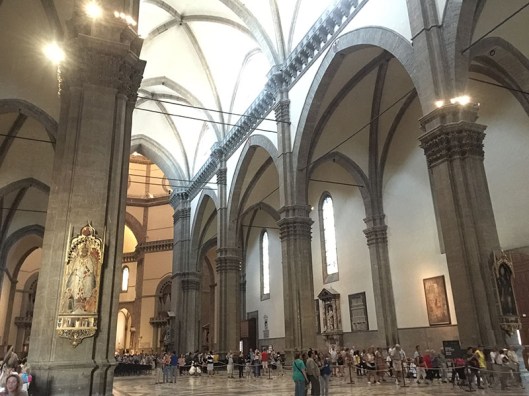
The Cathedral Santa Maria del Fiore – amazing and immense gothic basilica
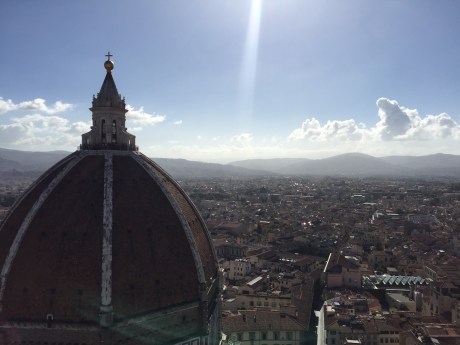
Brunelleschi’s Duomo – an amazing rotunda atop the cathedral
The underground archeological site below the Cathedral, Santa Reparata
The Baptistry, a large domed building across from the Cathedral
the Opera del Duomo Museum
We bought a combo ticket for all of these sites for 15 Euros, a great deal for what you see. You can buy the ticket online here, but we bought ours in person at the base of the Bell Tower, in an office that opened at 8am.
A note about the combo ticket – it’s good for 7 days after you purchase it, but once you validate it at the first site on the list above, you have 48 hours to see all the sites before the ticket expires. Plan accordingly.
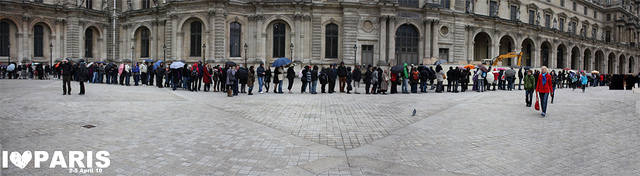
The ticket allows you to stand in the general admittance line for each of these sites. For the Cathedral and the Duomo ( the Dome ) we recommend you show up early, on different days. These lines get crazy-long very quickly. These two sites open at 830am, and we were in line for our visit to the Duomo by 745am with a very comfortable position, almost first. We splurged and spent 15 ( additional ) Euros apiece to see the Cathedral with a guided tour that enabled up to bypass the huge line.
A note about the Bell Tower and the Duomo: if you’re a little claustrophobic like I am, I can’t recommend strongly enough the importance of arriving early for the ascents of the Duomo and the Bell Tower. Both of these sites involve walking up serious stairs in very cramped passageways. If you are near the front of the line in the morning for these sites, this insures that after you ascend to the top and look around you can descend back to street level without pushing up against a mass of sweaty people in a cramped passage.
Up high view of the Duomo
As I walked past the seriously long line at 2pm in the sweltering sun this afternoon, I hope these poor people -love- what they are going to see, for they are surely suffering for the opportunity. Baking in the hot sun for 3 hours, then squeezing past their sweaty neighbors for a dizzying climb is not my idea of a good time on vacation.
That being said, the views are amazing, inside ( the Duomo ) and out. But the tight spaces… ugh. Rough for me. The Duomo in particular.
Also, there’s this – the Duomo and the Bell Tower afford amazing views, but if you’re at all afraid of heights, these attractions probably aren’t for you.
The Bell Tower also has a line at times, but this seemed to vacillate during the day. We went early the first day, buying our tickets and seeing the Bell Tower with no line, then as I’ve mentioned spent the additional 15 Euros to jump the line for the Cathedral ( and the crypt Santa Reparata ), and then the next day got in line early for the climb up to the top of the Duomo.
atop the Bell Tower
The Baptistry has no line to speak of, nor does the Opera del Duomo Museum, which are both really a neat experiences. At the Museum you see up close many pieces that were made for and once a part of the Cathedral.
Other sites
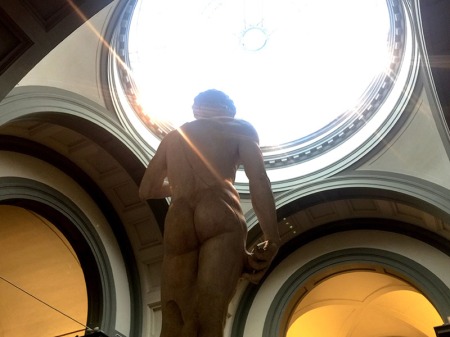
We purchased tickets separately to see Michelangelo’s David in the Academia Gallery. We recommend spending a little extra and getting the time stamped version of these tickets. Also, if you buy tickets online make sure you get printed out versions from the little kiosk across the street from the entry. Ugh.
Getting here early probably helps, but our stamped time was for 545pm. We stood in line for about half hour and made it in almost exactly at our scheduled time.
David’s ass.
Our favorite spot for gelato was “La Milkeria” with their homemade masterpieces, perfect on a hot day.
the dome of The Baptistry
We didn’t have a favorite spot for wine or cappuccino; there were too many perfect places everywhere we looked.
Our favorite place to laptop and do a little work was The Cafeteria delle Oblate, near The Duomo. It’s not like any cafeteria you’ve ever been to – it’s an amazing multi-level open air space with great food, wine and other drinks and free wifi. It’s frequented by students and tech workers, and really is a pretty sweet spot, with a view of the Duomo.
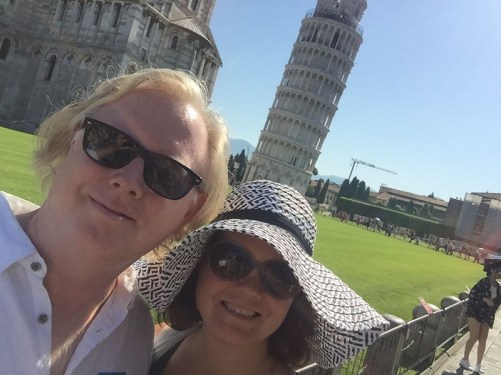
We took a day tour to Pisa to see the leaning tower and the local cathedral. The same tour brought us to the amazing Tuscana World Heritage site of San Gimignano, and the city of Siena. If we had to do it all over again, for the timing of this tour… It would have been perfect to spend a few hours in Pisa and a few hours in Siena, and another tour to spend all day at San Gimignano. But we got amazing pictures.
Pisa.
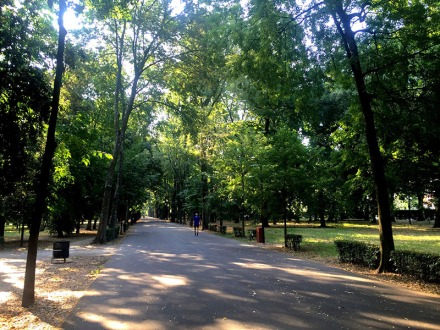
For our place – we stayed at an AirBnB right near the Talenti tram stop, about a 40 minute walk from the Florence city center and it seemed like a perfectly fine option. neighborhood markets and lovely people, as we’ve detailed elsewhere. This put us close to the amazing park just north of the Arno river and west of downtown Florence.
A great park along the Arno River
We rented bikes at the SMN train station ( the main one in Florence city center ) for a day for 10 Euros apiece. The bikes were nothing special, but we had an amazing day going through this park in the morning and through Florence itself later on. There is also a bike route that circumscribes old Florence, but there’s really very little to see along this route. We recommend taking your bike into Old Florence despite the crowds, and possibly across the river at Ponte Vecchio.
Those are the highlights that we haven’t discussed elsewhere on the blog. We have a week left and we will try and see a jousting, a concerto, and a few other things before we wrap our stay up. If you have any must-sees, let us know.
A buddy of mine is visiting the Happiest Place on Earth at the moment. On FB, he mentioned that there at Disneyworld there were some parents pushing their way forward in line, and how it was mostly people from other countries.
I don’t know about you, but I see this, and it makes me crazy.
Maybe it’s me getting older, but it feels like I am more aware of these little rules all around us that just make things “go better.” Minute assumptions or agreements we all kind of make so society doesn’t run off the rails.
Using turn signals, letting people off the elevator before you try to get on, and standing in an organized line. Putting your luggage inn the overhead so that others can fit theirs, too. Eating your meal and then leaving the restaurant, so they can fill the table after you.
You know, “normal.” When we don’t just do these simple things, chaos ensues, and it bothers me at a level so deep it’s embarrassing, sometimes.
But here’s the thing
These assumptions of normal are different all over the world. Of course I know this in an academic way, from my schooling. I know this in a rational way, like any educated person does – disparate cultures are different, and have “different ways.” All of this knowledge goes out the window, or really never entered my mind, when I see someone jumping line.
What?
Fuuuuuuuuuuckyyyouuuuuuuuuuuu, buddy. I don’t care where you grew up. Get back to the end of the line and wait your goddamn turn to buy the new Harry Potter and the Chamber of Gandalf book, before I make a Gladiator-level spectacle here. Or have an aneurysm while I quietly fume.
It happens when I’m traveling, too. Where the hell is my waiter? All these people drive like madmen! Why can’t we even all just stand in a simple line?
This is of course, ridiculous of me. Let’s talk about standing in line, in America.
In America…
If you grew up there when I did, when you were in Kindergarten or 1st grade some teacher yelled at you or whooped your ass until you learned to stand in a straight line.
Standing in line was never fun; you had to keep quiet, not be disruptive or poke people. you were to not make fart noises, and just be patient until you got to the head of the line. Where you quietly did your business then GTFO thank you, so the next kid could pay for their Salisbury steak. Or check out their copy of Green Eggs and Ham. Or whatever.
So – no fun, keep quiet, no pushing, be patient, it’ll be over sooner if we all just cooperate, don’t be an asshole; it’s more efficient this way. And again: no fun.
That sums up how we feel about lines in American, drummed into us from childhood. A few things we can extract from this: long lines immediately cause stress, even if there’s no other “bad” stimulus laying about. Also, standing in line is kind of a chore; you put in your time, you get your reward. No one would ever choose to stand in line or look forward to it, it’s kind of a necessary evil that will be over soon if we all just settle down. It’s an equalizer – we all stand in line. Mostly. If someone goes to the head of the line, there better be a -serious- fucking reason. Like, they happen to be Ryan Reynolds. Or they spent, like, 10x more on their ticket.
In the US, this is pretty deeply driven into us. So much so that, at the airport, even if someone had a cowbell around their neck and a standard bearer next to them with a big flag that signified they paid more than 10x what I may have for my ticket, I’d still be pissed if they moved to the front of my line.
So the airport people just make special lines, to avoid this social angst. This goes down much easier, to an American. I may resent the guy in that line for a moment, as I look at my cattle-herd of a line with forlorn despair. But that’s momentary. And maybe this is also American, but a few seconds later I think about how to work the system. “How do I get into that line?” And I start scheming. Live a better life? See up my pennies? Beat up Ryan Reynolds and take his ticket?
All viable options. But that idea of social mobility ( through smarts, money, or violence. #whatever ) is there – a very American thing.
Lines in other parts of the world – a quick survey
Russia – standing in line is an art form, honed by great experience. The Russians have forgotten more about line-standing than the americans will ever know. They also make serious use of the Different Lines for Different people idea.
Great Britain – same as the US, except maybe a little more accepting of the social strata. “Ho hum, this is my lot in life. I’ll piss down my leg and smile, rather than complain about this line and how I need to use the loo.”
US Hawaiian islands – the “Quantum Line,” where there is a cloud of potential, people in quantum super-position around the area of the register. When you observe the line by asking “who’s in line?” All the people collapse into a recognizable line. If only for a moment.
Italy – no recognizable queuing up, but maybe there’s one of those little number thingys. But the use of space is a free for all. Nudging up to the front or glass is perfectly fine, because they like to rub bodies here. Buonasera!
India – there are male lines and female lines. This is important because you slink up and spoon the guy immediately ahead of you, and the guy behind you does the same thing to you from behind. There is apparently a perfectly sane reason for this intimacy – to deter line-cutters, who have a refined art to edging in near the front of a line, and pretending they never saw the line to begin with, shocked they’re being called out on it. Hmmmm.
Kenya – a no-line free-for-all, from an American point of view. Let’s talk about this, as a counter to American Line Philosophy.
Meanwhile, in Kenya
In Kenya, standing in line is at least as much about chatting with your neighbor as it is about getting a particular thing done. No one sweats waiting, because it’s like social time. And at the end there’s this bonus, and you get to order poultry. Or a train ticket, or whatever. If someone is in a hurry, they just move up to the front. This may involve body contact, but eh. We’re all friends here, right? If someone needs to go ahead, they need to go ahead. No problem for me. Why are they so busy? It must suck to be them.
So what does it all mean?
How we feel about standing in lines is a great insight into our own culture, but also the idea of what you think is normal and rude might be different in other places.
Do you think they have it “wrong?” That your culture is “right?” I’ll tell you this – regardless of how you feel about wrong and right, you can save yourself a ton of stress if you read up about a culture before you visit a place. “place cultural norms” and “place driving norms” and “place social norms” and “place gestures” are all great google searches. Be prepared for what everyone around you feels is right and wrong, regardless of what you might think. In your back yard, do things your way. In someone else’s garden… when in Rome, do as the Romans do.
Beyond lines or traffic or hand gestures… what else is culturally relative? Guns? Social mobility? Freedom of the press? Organized crime?
( If you like this post, or this blog, you can subscribe and get emailed whenever there’s a new post by clicking on the green “Follow” button, over to the left. )
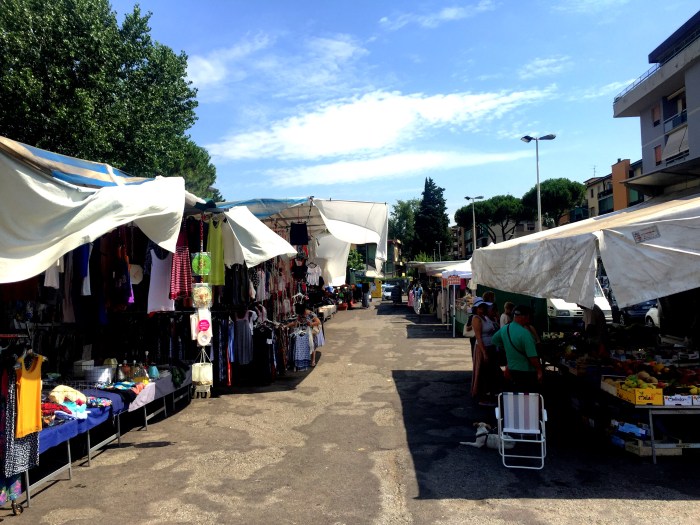
A street market in Florence – dog friendly, chair friendly.
I grew up in the suburbs of Chicago. We drove everywhere, especially to the store. When we shopped for food we bought in bulk. We also ate out quite a bit, even if it was just McDonalds, and I never really picked up the cooking thing. Later, even when I lived in the heart of Chicago on my own, I mostly ate out. I very rarely made anything at home, or shopped for anything other than what I thought friends might want if they stopped by.
I’m now living in Florence for a month, and my time in Italy so far is wonderful for lots of reasons. One of those reasons is trying a different lifestyle when it comes to food.
I’ve done some out-there things before when it comes to my meals: I’ve lived for long stretches almost entirely by eating out. I’ve also done the “Master Cleanse,” where the only thing you take in for close to 12 days is lemon-flavored water with a little maple syrup and cayenne pepper. I’ve spent half a year eating Vegan. What I haven’t done is lead that neighborhood lifestyle, where you go to the market every day or so, buy fresh food, and prep it for all your meals.
That is, until Italy.
Italy in a nutshell, and How to Live the “market lifestyle”
This will not seem strange to a few of you perhaps, but for me it’s hands-down the best part of this experience so far. Basically the pattern of the market lifestyle is this:
wake up early before it gets mind-bogglingly hot
stroll to the local market a block or so away
buy a few fresh things you need for meals today, and maybe part of tomorrow
tomorrow, repeat
Maybe all the people of Italy aren’t doing this, but from what I can see, many of them are. And I have to tell you, it’s every bit as cool as it sounds, or people say it is.
I eat much better, hands down. I have a bit of exercise built into the day, and I feel like I’m getting things done. The quality of food I’m taking into my body every day is hugely improved. I feel more self-sufficient, and also there’s built-in quality timeas you’re going about hunting-gathering-preparing. Also, it’s so much cheaper to live this way than the way I’ve been doing things for pretty much…ever.
I’m talking about markets here, the kind that setup in a lot or along a street somewhere, not individual street vendors.There are slightly different rules and expectations when dealing with a lone street vendor, as opposed to people in the neighborhood market.
I’ll focus on the market in this post. Here are some pointers and observations about shopping in the neighborhood markets here in Florence, that seem to inform well on the good people of Italy and life here in general.
The markets are daily events, walkable from where most people live. This isn’t a special “last Friday of the month” kind of thing; it’s every day. And though I’m not sure if markets are this prevalent everywhere, but it certainly seems and sounds that way. Within walking distance of where we’re staying there are 2 markets, every day, and this is nowhere near the city center. Traveling to the city center, you can see and read about other markets.
You can buy food, but also more. A wide variety of food including meats, cheeses, breads, fruits and veggies can be had at the markets. It’d be very hard to find something processed; it’s all fresh. Milk, wine, and other drinks are a little less common. In addition, you can also buy housewares and clothing at these markets, many of the little items that would be handy to have during the day like a spatula, a new shirt, or a wallet, things you might not need to replace often but wouldn’t want to drive to a big box store for can be found here.
You greet the proprietor, or wait for them to greet you, before you start shopping. This is traditional, and while they might in fact take your money if you don’t do things this way, you’ll be treated very coldly if you skip this step and just start shopping. In general, everyone from proprietors to customers are very friendly.
Prego, almost no one will speak English. You’ll learn very quickly to get by with pointing, sign language, speaking slowly ( as if this helps someone who doesn’t speak your language understand you ), and learning a small bit of Italian.
You don’t grab something, you point to it. It’s considered very poor form to just grab some fruit, or some item you’re looking to buy from the market. Much better is to catch the attention of the proprietor and point, smiling. They will pick it up and hand it to you. The American way of squeezing all the veggies until you find the right one is not acceptable at the Italian market. The idea is that all the veggies and fruit is fresh, and that no one wants stuff that’s been handled by every potential customer. Also,when they ask you how much you want of something, they are expecting you to tell them how many people what you’re buying is supposed to feed… not an amount like “a dozen” or “half a kilo.” Learning the phrases for “just one person” or “a few people” is very helpful. And yes, this is a little arbitrary, but it’s how things are done.
There are no lines. Maybe you take a number. Queuing in Italy is much different than it is in Britain or France, for example. And by “different,” I mean “no one ever stands in a line.” People either gather towards the front in a mass so they can point, or they take a number ( many stands/businesses have that little number dispenser thingy ) and wait to be called. There is very little conception ( or love for ) standing in line.
There’s really no concept of personal space. People will step right in front of you, or butt up right against you. In the US this is seen as the height of rudeness but in Italy there’s just no sphere of “your space” around you. If people get close to you, they are being friendly, accepting you. Also, another consequence of the no-space/no-line thing is that people will just move to stand right in front of you. If there was space there, clearly you didn’t want to stand in that space. Knowing this ahead of time will save you some stress,and maybe some arguments. This was is tough for me to get along with, but it’s much easier learning to accept it and be cool than to fight against.
Samples, yes please. if you’re shopping for food, most proprietors will offer you a sample, and will provide one if you ask. This is considered normal, if you’re making a decision.
Haggling – maybe. Haggling for price is usually perfectly acceptable if there aren’t others waiting, but if you attempt to haggle and gain no ground at all, like your attempt isn’t even entertained or considered, best not to push. At the markets, there is no expectation of haggling; you’re perfectly fine paying the listed price. This is different between the markets and buying from street vendors.
No-one is in a hurry. And you shouldn’t be, either. There is little or no sense of urgency anywhere to be found in the Italian street market, or as far as I’ve seen in Italy in general. And you should not expect any or bring any sense of urgency with you. The pace is slow and enjoyable, and deliberating about buying this thing or that thing is never rushed. If you’re in a hurry, maybe best not to go to a proprietor or stand with others who will be served ahead of you.
Coins are always better than notes, for payment. Things will be much cheaper than you ( as an American who grew up in the US, I’m supposing ) might think. Also, oddly, there is a shortage of Euro coins in Italy and great preference is shown at the street market for people who spend in coins. If you attempt to buy anything with a note more valuable than 10 Euros ( provided your thingy costs less than that ) you could very well be refused. Additionally, there is no sales tax in Italy; if something is listed at 1.20 Euros, that’s what you’ll pay. No little add-on.
They’ll chase you down to give you 10 cents in change. It’s pretty important to people, apparently. I’m not sure if this is the appearance of honesty, the appearance of not needing the extra 10 cents, or what. But someone will come running after you with your change.
You say goodbye on the way out, like your mom taught you. This goes along with greeting the proprietor, a common ritual and part of the expected courtesy. When you’re done, say thank you and good bye… don’t just walk away. This would be classless, and reflect poorly on your mother. Bless her.
The neighborhood market is open early, done by hot. Especially in the summer, the heat is intense in much of Italy. The neighborhood market is open early to serve people before they go to work, and usually shuts down before noon, to avoid the intense heat. And by “shuts down” I mean they’re done taking everything down by noon, so the proprietors don’t need to be out in the heat; not just so that the customer doesn’t have to be out there.
All in all this conveys a sense of casual, friendly, community-mindedness that seems much more common in Europe, and especially pronounced here in Italy. I’ve bene to several small towns in the US of course, and while I thought people were “friendly,” this is definitely saying something very different than describing them as “open” and “warm” to me as a clear stranger, passing through. Italy goes in for the embrace, and isn’t afraid of a little body contact.
Around the world, “the web” detects where you’re at, and does what it thinks is best.
Really, websites, servers, code that makes up “apps” decides “what’s best,” but for most people, it’s the web that’s doing this. the distinction is pretty meaningless to most people, so we’ll go with it.
So if you live in the US, Google serves you up Google.com, Amazon serves you up Amazon.com, and AmericanAirlines.com serves up… yea, you guessed it. Text is in English, transactionsare in dollars, and smiles are had all around.
If you live in the US and are traveling the world, things are different online, and buying things gets interesting. If you’re in Italy and type “google.com” into the address bar of your browser, or click on a bookmark or whatever that usually takes you to Google’s homepage, you’ll actually go to “google.it”
if you’re not a web nerd and you also live in the US you might not know this, but countries all over the world have their own versions websites. Small ones, and the big ones that have presence all over the world have different versions, depending on where you are. Even in Britain, where they speak a version of English, you’ll get sent to Google.uk, not Google.com.But let’sstay in Italy for now.
At Google.it, your results are in Italian. Which is a little strange, as clearly I’m still logged into Google and Google’s servers ( should ) know my default language is English. But whatever. Yea, it’s all in Italian. Even more subtly, my results are mixed with an Italian-centric kind of flavor. If I type “football” into Google.com back home, I’ll likely see the homepage for the NFL in the top ten results.
Not so in Italy. “NFL.com” isn’t even on the first page. Of course, because in mostly not-US places int the world, the term “football” means “soccer,” not what Tim Tebow plays. Lots of websites do this, but the big ones definitely do this. As a traveler, this is a bit of a thing.
Google’s results here in Italy are Italy-centric, and also in Italian. Hmmmm. Amazon does it differently – If I go to Amazon.com, I’m taken to Amazon.com, but the biggest thing on the homepage I see is a banner saying “You’re on Amazon.com ( American flag pic ), but do you want to go to Amazon.it ( Italian flag here )?” So Amazon recognizes, takes me to where I said I wanted to go, but asks if I want to go to a different place.
If I stay on Amazon.com, the US site, I won’t be able to order anything that gets delivered to Italy. Or anywhere except the US. If I want to order something and have it sent to where I am in Florence, I have to go to Amazon.it.
If I go to Amazon.it and order socks, I can have them shipped to my current address in Florence, and what’s even better is I can pay in US dollars with my American MasterCard. This is a big deal, because lots of sites don’t do all this for you on the fly.
AmericanAirlines.com, for example will take you to AA.com, allow you to book a ticket, display in English, charge you in Euros, and tell you everything is fine.
But everything is not fine.
Because my American credit card is with an American bank, it uses US dollars. When AA.com assumed I wanted to use Euros because I was sitting in Italy when I bought the tickets ( even though I have an account at AA.com and they know who I am, allegedly, and that I have always used USDs in the past )…things go wrong. AA.com tries to charge me in Euros, and this doesn’t go well.
Duh.
Even when I go back to AA.com and do the transaction with the monetary thingy set to USD, the site still attempts to process the transaction in Euros. I wound up having to call AA and do my flight over the phone.
What does this all mean, Pete?
Websites, the companies that own the servers and build the sites you shop on have the ability to determine where in the world you are, and they should also know things like your default language and currency, but lots of sites that should know better are still screwing all of this up. If you’re American using an American bank card or credit card when you travel and are looking to buy things online, do this always:
Make sure the language selector is set to set to English; the US flag is they have it, the UK one if they don’t. ( note – learn what the UK flag looks like. )
Make sure the currency selector is in US Dollars.
These two simple things will give you the best shot at your transaction going off without a hitch. And also,always look for that little lock icon in the address bar when you’re buying something. If it’s not there, do not put your credit card info into that website’s forms.
#themoreyouknow
“One day the people who didn’t believe in you will tell everyone they met you.”
I grew up in the US, and until fairly recently in my work life, if I wanted a day off to head out to play, I had to ask.
And I also had to hope that it was cool with my supervisor that I’d take time off, and that my request got approved. I always felt a little guilty about even asking.
This is my own hang up, but my guess is this came from early childhood, where you needed some serious reason ( in my house ) to call off from school and there was ( Catholic? ) guilt involved whenever it happened.
And lastly, if you wanted to take a day or a week and there was something serious going on – a deadline, some big project, forget it. Your time off was not happening.
This is not how it happens, by and large, in the UK.
What?
Over here, your time off is seen as part of your compensation, something you’re entitled to without reservation. You might say this about your US by-law-mandated time off, but let’s look at that.
In the UK there’s no “asking” for time off; you inform your supervisor, and that’s that.
No reason necessary, no justification. No silly “Doctor’s Note.” Is it smack in the middle of a serious thing? No problem. Your benefit of a paid day off isn’t just for easy days, it’s for any time you’re supposed to work. So it’s cool. Whenever.
That’s the thing. Your time off is considered part of your compensation in a very real way, and just like ( almost ) no one would think to mess with your pay for hours worked or your health benefits as prescribed by the employer, no one thinks of interfering with this other benefit of taking time off, either.
As I’ve said, I’ve been very fortunate on this point since I moved over to the tech field. I’ve had more freedom to do what and when I want, but even with my seniority, luck, great managers, and comparatively laid back field, the difference overall is still pretty striking. It is definitely truth that for a long time I’ve always been able to ( mostly ) inform about days off, instead of request. But either because of my background, my previous experience, or whatnot… even when I knew this was cool, part of me tried to argue that it wasn’t cool.
Before I switched to tech, I worked for a long time for the casinos in the Midwest. And believe me, getting time off was true to every US stereotype there is. Even as adults, you were mostly you were treated like school children, and I think it was this kind of attitude that eventually led me to do an serious career reset in the late 90s.
Seeing this difference here in the UK makes me smile, like the kid who sees how other kids are allowed to misbehave. (^_^
Making app purchases from ( for example ) iTunes or the App Store can be complex and throw up multiple hurdles. Take for example buying and displaying train tickets.
In Europe it’s possible to buy train tickets from a variety of websites; that train company’s site is always an option, but often not the most economical and sometimes not the most accurate, strange as that may sound. With a little research, you can find the site that’s right for your ticket from London to Athens. Or wherever. In our case, Marseilles to Paris.
The setup
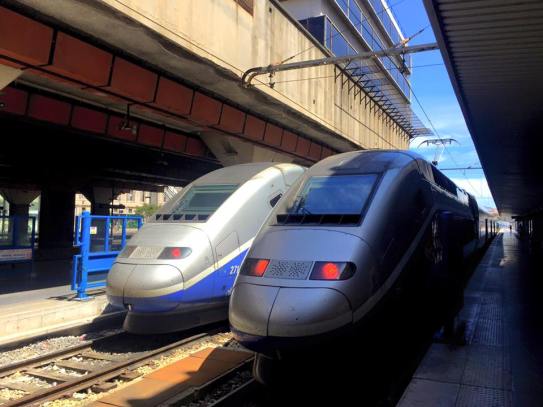
I’m not a train “nerd,” meaning I don’t know the types of various engines in use, anything about schedules or trackage. I barely know that the term “motive power” has to do with engines, but regardless I love traveling by train. So when in France, I wanted to take the high speed TGV from Marseilles to Paris, and Kim was happy to oblige me.
I did the research, bought tickets. The website told us a few times to “Make sure and print out the tickets before you get to the station, or there will be an additional fee.”
This isn’t a post about the wisdom of doing this, but I will say, if you can, maybe save yourself some heartache, and print the tickets out.
But, I didn’t do this.
Being used to how things are in the US, I figured I’d just do as I do there. Go to the site ( or something ) and “bring up” the ticket on my phone. I didn’t understand this at the time, but when I do this in the US, many things are happening:
I am doing this all on a US phone, with a US number
I am grabbing the relevant app from the US app store
I am paying for the app ( or stuff within it, even if that amount is $0.00 ) with a US credit card
I am paying in US dollars
And now, the challenge
Some or most of this won’t be true if you’re doing the ecommerce thing while traveling abroad, this can get a little sticky, so I’ll try and explain using my train example.
We get to the station in Marseilles. No one at the large, ornate ticketing counter can print our tickets, because they were purchased through some company ( iDTGV ) that exists and is perfectly cool to sell them, but doesn’t have an office at the station. Our passage is probably valid, but without printed tickets, we’ll have to pay service charges and have everything sorted out. On the train, which will be moving at some amazing speed. Bleh. The nice ticketing lady tells us they’ll need to scan a QR code on the train, and she’s sure we’ll figure it all out. Just not there at the ticketing counter.
So, we leave the ornate counter, and wander the station a bit.
On my phone, I go to the email I got from the company. Of course it says something to the effect of “this is your itinerary, your proof of payment, but absolutely in no way is this a ticket. Please print your ticket from the following link…” And of course no QR code.
Gumble, grumble.
We regroup. I click on the link from the phone with the lounge wifi – did I mention this is after bluffing our way into the First Class lounge without tickets but showing our definitely-not-tickets-email-on-a-phone. Very classy – the email I click on doesn’t show a bar code, and doesn’t seem to be able to bring up the ticket page. More grumble. But the email has a huge link for the issuing company’s iPhone app.
Huzzah! I think.
I click, and this is where the real fun starts.
“The Fun”
“You are registered at the US app store, but attempting to access an app from the French app store. Do you want to change your settings?”
Um, sure. Hmmmm. I can always switch back, right?
Right?
I click “Settings” and eventually ( still more grumble ) figure out that you can’t do this from the phone. I think to look in the US store for the app – maybe the link was just to the French store and it exists in the US store, yes? Worth a look.
But it doesn’t.
So, I bust out the laptop, look at the clock ( 20 minutes now before boarding ), and navigate to the app store to change my store to the French one. I do this after jumping through some hoops. I look up the app and go to download it, but even though the app is free and will cost E0.00, I’m stopped and told I’d need a French credit card to make app purchases in the French app store. No downloads of any kind until I enter a valid French credit card.
What. The. Fuck.
In the next ten minutes, it’s not likely I’m going to apply for and receive, or otherwise procure a valid French credit card. Soooo I switch my settings back to the US store and close it. I take a mental inventory:
To display tickets on my phone, I need the app.
To get the app, I need to register with the French store
To get anything from the French store, I need to have a french credit card
None of this is going to happen, so I abandon this line of thinking ten minutes left before we board. What have I missed? I recheck the above assumptions. How can I do all this without suffering the Silly American embarrassment of explaining to the ticket person on the train that “yea, I read the 3 places it said to print these out, but I didn’t print them out.” …?
The laptop still open, I go to my email, find the not-a-ticket itinerary email, and click on the ticket link there, the one that would not come up on my phone.
It comes up! QR code city, for Kim and I both.
Huzzah! ( For real, this time )
Now I do a little digital acrobatics – screen cap the tickets from the laptop, email them to myself, open this email from the phone, crop the screencaps to be just the ticket with the much-vaunted QR code:
I email Kim’s to her. And say a short prayer they won’t kick us off the TGV, or impose serious Silly American fines for us using our clearly-hacked tickets.
As it turns out, they do neither. They accept our screen-capped, cropped tickets as if they were issued by the snooty French app itself, from the French store, paid in Euros. Glory Days!
And a pain in the ass.
But for our trip from Paris to London ( on Eurostar ), just a few days hence… it turns out Eurostar is not as snooty as iDTGV, and indeed has an app in the US iPhone store where Pete can spend USD.
Coming soon – part 2 – adventures in ordering from Amazon while in London!
Internet is of course essential.“I need a good connection” is a simple phrase, but there are a few things that comprise this thought. It needs to be either free or amazing. With so many free options out there, paying an unknown company in an unknown place for Maybe Decent wifi is not really an option; too risky, as there is too much free all around. This means hunting. And hunting before that meeting or essential contact you have, because you have to know the wifi is good and stable before meeting time, right? Further, your free decent internet is often located in a loud-ass environment. So…the hunt for free decent, quiet internet that won’t bounce you off after 20 minutes is kind of a thing. A hobby you get better at. There are apps to help with this.
VPN software is also essential. If you haven’t used it, it might not seem like it. But using free wifi is a little like putting your mouth on a public water fountain – eeeeeeew. I know that’s an ugh analogy, and the danger really is in the other direction with free public wifi: nefarious peeps on laptops, phones, or whatnot peeking into the network and watching traffic, leaping from machine to machine. Don’t be a lillypad for these guys – get a VPN. It’s an app you download ( onto the laptop or phone or whatever ) and turn “On.” Then you forget about it, and you’re an order of magnitude more secure. I use “Private Internet Access” ( no affiliation ) for about $35 a year and really like their service.
A schedule of continual movement makes working hard. If you take short hops, and here I mean if you stay in a place for just a few days before moving on to the next place, this really isn’t a schedule that’s conducive to getting work done. It seems like you spend those first twelve hours winding down and vegging, getting acclimated and having a pint. The last twelve hours before you leave you’re spinning up by packing, checking everything, traveling to the airport/train station/caravansary and going through that process. Another chunk of your time will go to finding the next place you’re going to stay, and making all those arrangements. All of this gobbles up more time than you’d think, even when you get good at it with practice. So vagabonding and staying put in laces for longer makes much more sense; this time to settle in is gold.








 pau hana life