“One day the people who didn’t believe in you will tell everyone they met you.”
– Johnny Depp
“One day the people who didn’t believe in you will tell everyone they met you.”
– Johnny Depp

I grew up in the US, and until fairly recently in my work life, if I wanted a day off to head out to play, I had to ask.
And I also had to hope that it was cool with my supervisor that I’d take time off, and that my request got approved. I always felt a little guilty about even asking.
This is my own hang up, but my guess is this came from early childhood, where you needed some serious reason ( in my house ) to call off from school and there was ( Catholic? ) guilt involved whenever it happened.
And lastly, if you wanted to take a day or a week and there was something serious going on – a deadline, some big project, forget it. Your time off was not happening.
This is not how it happens, by and large, in the UK.
What?
Over here, your time off is seen as part of your compensation, something you’re entitled to without reservation. You might say this about your US by-law-mandated time off, but let’s look at that.
In the UK there’s no “asking” for time off; you inform your supervisor, and that’s that.
No reason necessary, no justification. No silly “Doctor’s Note.” Is it smack in the middle of a serious thing? No problem. Your benefit of a paid day off isn’t just for easy days, it’s for any time you’re supposed to work. So it’s cool. Whenever.
That’s the thing. Your time off is considered part of your compensation in a very real way, and just like ( almost ) no one would think to mess with your pay for hours worked or your health benefits as prescribed by the employer, no one thinks of interfering with this other benefit of taking time off, either.
As I’ve said, I’ve been very fortunate on this point since I moved over to the tech field. I’ve had more freedom to do what and when I want, but even with my seniority, luck, great managers, and comparatively laid back field, the difference overall is still pretty striking. It is definitely truth that for a long time I’ve always been able to ( mostly ) inform about days off, instead of request. But either because of my background, my previous experience, or whatnot… even when I knew this was cool, part of me tried to argue that it wasn’t cool.
Before I switched to tech, I worked for a long time for the casinos in the Midwest. And believe me, getting time off was true to every US stereotype there is. Even as adults, you were mostly you were treated like school children, and I think it was this kind of attitude that eventually led me to do an serious career reset in the late 90s.
Seeing this difference here in the UK makes me smile, like the kid who sees how other kids are allowed to misbehave. (^_^


Making app purchases from ( for example ) iTunes or the App Store can be complex and throw up multiple hurdles. Take for example buying and displaying train tickets.
In Europe it’s possible to buy train tickets from a variety of websites; that train company’s site is always an option, but often not the most economical and sometimes not the most accurate, strange as that may sound. With a little research, you can find the site that’s right for your ticket from London to Athens. Or wherever. In our case, Marseilles to Paris.
The setup
I’m not a train “nerd,” meaning I don’t know the types of various engines in use, anything about schedules or trackage. I barely know that the term “motive power” has to do with engines, but regardless I love traveling by train. So when in France, I wanted to take the high speed TGV from Marseilles to Paris, and Kim was happy to oblige me.
I did the research, bought tickets. The website told us a few times to “Make sure and print out the tickets before you get to the station, or there will be an additional fee.”
This isn’t a post about the wisdom of doing this, but I will say, if you can, maybe save yourself some heartache, and print the tickets out.
But, I didn’t do this.
Being used to how things are in the US, I figured I’d just do as I do there. Go to the site ( or something ) and “bring up” the ticket on my phone. I didn’t understand this at the time, but when I do this in the US, many things are happening:
And now, the challenge
Some or most of this won’t be true if you’re doing the ecommerce thing while traveling abroad, this can get a little sticky, so I’ll try and explain using my train example.
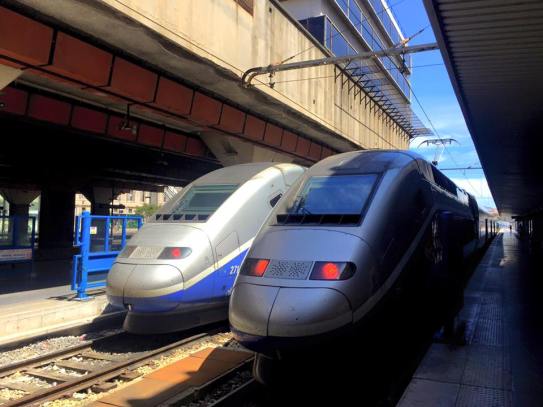
We get to the station in Marseilles. No one at the large, ornate ticketing counter can print our tickets, because they were purchased through some company ( iDTGV ) that exists and is perfectly cool to sell them, but doesn’t have an office at the station. Our passage is probably valid, but without printed tickets, we’ll have to pay service charges and have everything sorted out. On the train, which will be moving at some amazing speed. Bleh. The nice ticketing lady tells us they’ll need to scan a QR code on the train, and she’s sure we’ll figure it all out. Just not there at the ticketing counter.
So, we leave the ornate counter, and wander the station a bit.
On my phone, I go to the email I got from the company. Of course it says something to the effect of “this is your itinerary, your proof of payment, but absolutely in no way is this a ticket. Please print your ticket from the following link…” And of course no QR code.
Gumble, grumble.
We regroup. I click on the link from the phone with the lounge wifi – did I mention this is after bluffing our way into the First Class lounge without tickets but showing our definitely-not-tickets-email-on-a-phone. Very classy – the email I click on doesn’t show a bar code, and doesn’t seem to be able to bring up the ticket page. More grumble. But the email has a huge link for the issuing company’s iPhone app.
Huzzah! I think.
I click, and this is where the real fun starts.
“The Fun”
“You are registered at the US app store, but attempting to access an app from the French app store. Do you want to change your settings?”
Um, sure. Hmmmm. I can always switch back, right?
Right?
I click “Settings” and eventually ( still more grumble ) figure out that you can’t do this from the phone. I think to look in the US store for the app – maybe the link was just to the French store and it exists in the US store, yes? Worth a look.
But it doesn’t.
So, I bust out the laptop, look at the clock ( 20 minutes now before boarding ), and navigate to the app store to change my store to the French one. I do this after jumping through some hoops. I look up the app and go to download it, but even though the app is free and will cost E0.00, I’m stopped and told I’d need a French credit card to make app purchases in the French app store. No downloads of any kind until I enter a valid French credit card.
What. The. Fuck.
In the next ten minutes, it’s not likely I’m going to apply for and receive, or otherwise procure a valid French credit card. Soooo I switch my settings back to the US store and close it. I take a mental inventory:
None of this is going to happen, so I abandon this line of thinking ten minutes left before we board. What have I missed? I recheck the above assumptions. How can I do all this without suffering the Silly American embarrassment of explaining to the ticket person on the train that “yea, I read the 3 places it said to print these out, but I didn’t print them out.” …?
The laptop still open, I go to my email, find the not-a-ticket itinerary email, and click on the ticket link there, the one that would not come up on my phone.
It comes up! QR code city, for Kim and I both.
Huzzah! ( For real, this time )
Now I do a little digital acrobatics – screen cap the tickets from the laptop, email them to myself, open this email from the phone, crop the screencaps to be just the ticket with the much-vaunted QR code:

I email Kim’s to her. And say a short prayer they won’t kick us off the TGV, or impose serious Silly American fines for us using our clearly-hacked tickets.
As it turns out, they do neither. They accept our screen-capped, cropped tickets as if they were issued by the snooty French app itself, from the French store, paid in Euros. Glory Days!
And a pain in the ass.
But for our trip from Paris to London ( on Eurostar ), just a few days hence… it turns out Eurostar is not as snooty as iDTGV, and indeed has an app in the US iPhone store where Pete can spend USD.
Coming soon – part 2 – adventures in ordering from Amazon while in London!
Internet is of course essential. “I need a good connection” is a simple phrase, but there are a few things that comprise this thought. It needs to be either free or amazing. With so many free options out there, paying an unknown company in an unknown place for Maybe Decent wifi is not really an option; too risky, as there is too much free all around. This means hunting. And hunting before that meeting or essential contact you have, because you have to know the wifi is good and stable before meeting time, right? Further, your free decent internet is often located in a loud-ass environment. So… the hunt for free decent, quiet internet that won’t bounce you off after 20 minutes is kind of a thing. A hobby you get better at. There are apps to help with this.
VPN software is also essential. If you haven’t used it, it might not seem like it. But using free wifi is a little like putting your mouth on a public water fountain – eeeeeeew. I know that’s an ugh analogy, and the danger really is in the other direction with free public wifi: nefarious peeps on laptops, phones, or whatnot peeking into the network and watching traffic, leaping from machine to machine. Don’t be a lillypad for these guys – get a VPN. It’s an app you download ( onto the laptop or phone or whatever ) and turn “On.” Then you forget about it, and you’re an order of magnitude more secure. I use “Private Internet Access” ( no affiliation ) for about $35 a year and really like their service.
A schedule of continual movement makes working hard. If you take short hops, and here I mean if you stay in a place for just a few days before moving on to the next place, this really isn’t a schedule that’s conducive to getting work done. It seems like you spend those first twelve hours winding down and vegging, getting acclimated and having a pint. The last twelve hours before you leave you’re spinning up by packing, checking everything, traveling to the airport/train station/caravansary and going through that process. Another chunk of your time will go to finding the next place you’re going to stay, and making all those arrangements. All of this gobbles up more time than you’d think, even when you get good at it with practice. So vagabonding and staying put in laces for longer makes much more sense; this time to settle in is gold.
Pete and I just left France. Even as we sit at Starbucks in London, enjoying the familiarity of a large, 12 ounce cup of coffee, I already feel a bit nostalgic. We are here, waiting to connect with a good friend of mine who is graciously hosting us for the next couple of weeks.
But… for a few more moments, before I begin to embrace a new city, I’d like to take a few moments to remember France. The south of France and Provence. Specifically, ‘Savon de Marseille’ or ‘Marseille soap’.

Don’t get me wrong. There are so many things I love about France. The beautiful country side, la patisseries, the wine, the people we met and certainly gaining an ear for and practicing my French. These are just a few of the many wonderful things.
I do love soap, however, and Savon de Marseille is an excellent soap with a long history and beautiful presentation. As soon as I walked into Maison du Savon de Marseille in Aix en Provence, I was smitten. It took all of my will power not to pack a second backpack full of soap. A few fun facts:
Also, I think it very possible that in a past life, I was a soapmaker in Marseille. Check out these facts. First, I make my own soap. Also, I used to sell my soap to people and made a living for a while doing this. And the biggest suggestion that makes it possible I did this in a former life-check out how I used to display my soap:

Whenever we travel, we look for little bits of ourselves in the unfamiliar. It’s comforting and encouraging to know for a fact from our own experience, that humans living far from us, are not really so different. The French love soap and have a 600 year old recipe which is still being used today! That is soooooooooooooo like me!
So the next time you find yourself in France, or any shop selling Savon de Marseille, please buy a bar or two. You will be treating yourself and participating in a tradition spanning many generations.
 A great lesson here about the difference in cultures, as well as painting your own life around you.
The first few cafes Kim and I sat at here, the service was awful. Really crappy.
It took forever for someone to come around, they were gone for long stretches at a time, and when we were done, it took an age for them to come. Both times, we gave up waiting for them to come with the bill; we finally got up and asked for it. Frustrating.
And, of course, we were being silly.
We weren’t wrong to be frustrated maybe, but the source of our frustration was the two of us carrying our expectations of how service should go, learned in the US, with us into France. Not shitty service.
This is such a subtle thing, you don’t even notice it. What’s normal for you seems normal everywhere, right?
Here’s what I learned somewhere when I was young: when I sit down, I want prompt service. Someone attentive. I want them watching me eat; when my drink is low I want them to magically appear to fill it. When I’m done, I want them to magically re-appear with the check, so I can leave and get on with living my life.
Everyone would want this, yes?
No.
My own description of what “good service” is ( above ) might resonate with you, but it’s rooted in my American upbringing, to be sure.
I have serious expertise in cultural anthropology, and yet it didn’t occur to me that maybe what I was experiencing in France was not shitty service. When all this was going on, I didn’t throw a stink like some people might; I just sat and stewed a bit. Ugh, what lousy service.
I brought with me an underlying assumption we’re taught pretty early in America. At least in the Midwest: be economical with your time in a restaurant or cafe. Take as long as you need, but don’t loiter. Loitering is bad manners; it keeps the table occupied while the server could be earning tips from someone else, the place could be charging someone else for food and service.
This isn’t your mom’s place – eat and GTFO.
Meanwhile, in the French cafe-goer’s mind…
Of course, in France, the whole idea here is different. There’s a entirely different fundamental assumption, and there are different norms in play.
Knowing this makes life clearer, and better.
The French don’t want to be hurried. That feeling I loved at my favorite coffee shop back home in Lihue? The French want that -everywhere- in France. They demand it.
They want to sit, relax, loiter, veg, meet with friends, take three hours if they have three hours to spend. And they want this at all cafes, not just the “home” cafes where everybody knows their name.
This is normal, and expected here.
French service is based around these norms and expectations. The waiter/waitress will give you serious leeway by default. They won’t be on your every few minutes. There is zero expectations of rushing, or moving through so more people can sit in your current seat. Take your time.
Don’t rush. Enjoy life.
Loiter.
A French server wouldn’t dream of hassling you with the bill, or breaking your rest with constant visits. It would not be respectful.
And if you’re on a schedule… just mention this.
“Excusez-moi monsieur,” you say. “I am a rushed American and I have tickets to this one French Thingy. Can I get my bill when I’m served my meal?”
“But of course.”
That’s it. If you want to not wait, to not loiter, just ask. Of course they’re cool with that.
The lesson
The thing is, it was really easy to not even ask. It was very easy to instead just feel like the service sucked.
And from there it was easy to jump to all sorts of dumb, in-retrospect-embarrassing conclusions. “It’s probably because they know we’re Americans,” and so on.
This was wrong. And BS. And childish.
One thing I really, really want to work on this trip is being in tune with my assumptions and expectations, and how much these and my own frame of mind contribute to my stress. And the fundamental understanding that this point of view is a choice.
I choose to be affronted, offended. Just because I don’t know what’s going on is not an excuse or an explanation or rationale. If I begin and end at feeling stressed, insulted, and affronted… this is because I have made a choice to be.
This starts and ends with me.
Here in France, all most people really want to do is smoke, and treat you well.

This could be the title of my memoirs – “Stress, Travel, and Breakfast.”
Not the final title mind you, but the working title until I think of something cooler. This particular post is about how a breakfast of Kellogg’s Special K cereal helped ease The Crazy a bit while traveling.
The term “cognitive load” ( CL ) comes up in my field, when I’m designing screens/interfaces/flows through different online presences. CL is that amount of mental processing an experience sort of “puts” on you, the hoops it requires of you to figure it out and proceed forward.
Vegging on the couch watching “The Voice” is pretty low cognitive load, while defusing a nuclear bomb in a deep-dive suit while colorblind is a high cognitive load.

For me lately, traveling seems to be somewhere in the middle of these two examples.
Ambient stress
While there is something liberating about giving up most of your stuff and wandering the earth for a year… there are sometimes day-to-day pressures adding to the cognitive load of living like this.
In addition to the press of people, not knowing the language, subtle differences in everything from road design to cafe customs, to being on somewhat of a schedule in the smaller hops from place to place, this all stacks; there’s a bit of cognitive load here. And lots of times it’s ambient, in the background and definitely affecting you, but not too obvious.
I’m a grown man with lots of varying experience in stress, but even with a full night’s sleep some of the days lately have been a little bit stressful, with all these above elements sort of piling on. A fairly high ambient cognitive load, leading to stress.
This has interesting effects. If the CL and accompanying stress is high enough, I forget how to act in basic situations, and use normal tools. Tollbooths and spoons come to mind. You get much dumber, in the moment.

In situations and experiences I design in my work, a user can always opt out of something if my design is imposing too much cognitive load. If I’m designing search interfaces, the short conversation after too much CL might be “Screw this; I’m using Google.” Wandering around Paris, it’s not easy to just opt out.
Well, I guess I could just stop what I’m doing, pull up a chair at any one of an endless number of cafes, and have a drink. At 10am.
Why not? I’m on walkabout.
(^_^
Or… I could take steps to reduce my CL, and up the things that make me calm. This is where Special K comes in.
While shopping for the daily food ( as one does, in France ) I came across a ridiculously inexpensive box of cereal that hadn’t entered into my conscious thought since childhood: Kellogg’s Special K. yes, the boring flakes you got when you really wanted the Tony the Tiger stuff. My mom bought Special K until I was, like, in high school.
I remember not liking Special K. I remember pining for Frosted Flakes. They’re Grrrrrrrrrrreat! after all. All these years for breakfast, I’ve never looked back.
But there in that store, that little voice I sometimes have in the back of my head said “Grab this,” so grab it I did. My little voice often makes sense. Or this may have been Kim. She also makes sense, much of the time.
And of course I loved the cereal.
It brought back memories of my childhood and my mom, or simple carefree times, and it was a much more powerful stress-reducer than you’d think. The combo of all those pleasant tone-setting thoughts and feelings in the morning before the day started really helped.
In conclusion
Stress can really be expressed as a kind of equation, I guess. Stress on the right side of the equals sign, part of it coming from some amount of cognitive load. You can lower stress ( the number on the right ) by reducing CL ( on the left ), but you can also add de-stressors at key points, kind of like negative values on the left. This works just as well, as getting rid of the stressors, the things that add CL, or just getting better at handing the stressors.
Not good with word-equations?
Find something that reminds you of good times in your childhood, and bring that back into your life somehow.


So, you decide you’re going to travel the world for a year or so. How exactly does that work with your smartphone?
My phone company ( Verizon ) would happily charge me an outrageous sum for some sort of “world access” plan that gives me a whopping 250mb of data per month, before it really starts charging me. To put this in perspective, the black and white line drawing above might be more than 250mb.
Well, okay, that’s not true.
But still. I’d gobble that up in a heartbeat, and then the money wheel would start spinning. I’m on the hook with them until November, so what are my options?
Google Voice, Skype, and a VPN.
Let’s stat out with the bad news – my phone will only work like a phone when I have wifi. In Britain or Ireland, that’s just fine. The busses have wifi. The outhouses have wifi. In southern France… I was lucky the Apple Store had wifi. So, there’s that constraint.
Also, people dialing my regular number and expecting me to answer won’t be able to get me. Even though I didn’t sign up for a plan, Verizon is also happy to just charge me world roaming rates, and let my phone work as it’s worked all along. This is also a non-great idea, and I’ve turned off my phone’s ability to do anything at all without wifi.
So. There’s that.
But with Wifi… I can get iMessages the normal way, text messages and voicemail from my non-Apple friends on the Google Voice number ( because before I left I liked the GVoice number and my regular number/phone ), I can dial your cell with Skype. I can dial a toll-free number with GVoice and the VPN. The Skype call costs pennies purchased through the Apple app store. The GVoice is free. Also, FB messeages ( and probably phone service ) work just fine with wifi as well.
Jumping through some hoops, I have mostly free service around the world so I can stay in touch. As long as I’m on wifi.
Yea, that’s a big “but.” One I’m still working through.
On the plus side: it’s good to be a little less dependent on our digital smartphone overlords.
Also, one thing Verizon gets right is that my phone is be default “unlocked,” which means if I’d like I can buy a simm card anywhere in the world, stick it in my phone, and have it work. It may come to this; I confess I do miss easy texting.
Have you ever been chased by Bond villain henchmen?
The ones on motorcycles I mean, that come out of nowhere? Have you driven on roads like that? Very thin with seemingly ambiguous signs and symbols, roads that tighten up to barely as wide as your tiny Renault where suddenly you’re face to face with Michael Buble’s touring bus?
This is driving, as it happens in the South of France.
Seriously, the roads are something interesting. Roundabouts everywhere, all sort of offshoots and directions, loops and meanderings. A high speed limit that most people don’t pay any attention to. Everyone tailgates, like, all the time. Was that your turn? A free parking space? A place that probably has really good bread?
Gone. Désolé.
Too bad. And good luck getting back to it, because the road follows some old horse track around the hill and through the wheat field, and doesn’t come back this way.
Motorcycles Everywhere. At least down here near Marseilles. The kind that are exempt from traffic laws, swarm like bees, and leave you standing still when you’re going 90kph.

I am not complaining. I am mostly amazed. Tho I am also a bit stressed out.
It seems like every time I drive, every place we go, it’s a test of nerves, a feat. It’s like being amped up on RedBull from the moment you turn the car on, til you turn it off. At least this has been my short experience, so far.
Kim teases me, says I need to be a little more aggressive, give it right back to the local drivers.
There’s something to be said for the overlay of stress that comes from being in a foreign country, the kind that soaks into the basic stuff you do and adds to the cognitive load. I’m not sure slipping into Angry Driver mode will help that. I’m usually the calm guy behind the wheel.
When we were renting at the Marseilles airport, the nice lady asked if we would like GPS for some fee-per-day. We thought about it for half a second, and politely declined. As if we hadn’t said a word, the lady continued “Okay, I’ll just put that on free of charge then.”
I thought she was being nice. Friendly to the visiting Americans. This might in fact be true, but she was also saving her countrymen a serious amount of headaches. Kim and I don’t have roaming data on this trip ( not yet, anyway ) and without GPS with my driving, we would have been in a ditch, or out in some scenic rolling wheat field within 10 minutes.
Oh well. Soon we’ll turn in the rental and give back the GPS. We’ll take the TGV up north to Paris, then Eurostar to London. We’ll be up there for a while… maybe the driving there is different?

 pau hana life