Almost a week on this island and I don’t know how I could be more in love with it. Naxos has beautiful beaches and great weather. Interesting stories and ruins which bring to life some of the Greek mythology we’ve grown up with. Great food and architectural aesthetic-the list goes on and on.
It’s hard to pick just one thing, but I think if I had to, the thing I love most about Naxos is that it is largely self sufficient, producing most of the food it consumes and then some. The largest of the Cycladic Islands, Naxos has large valleys and plains with fertile soil for many things.
Potatoes and Other Agricultural Products
The Naxos potato is celebrated throughout Greece. They produce so much here that they export them. I can attest to how delicious they are. Golden colored with a mild, almost sweet flavor, we’ve been eating plenty of them in the form of french fries and have even been cooking them ourselves. On our first trip to the market we bought a big bag of them.
Why are they so delicious? Well, the soil composition and semi-arid conditions are normally attributed to the good flavor. I would add that the celebration of them as something special and desirable contributes to that sweet taste.
Pulses (beans and lentils), olives, figs, grapes and herbs are a few of the other major crops grown on the island. Olive oil, wines and other products are made from these.
Animal Products
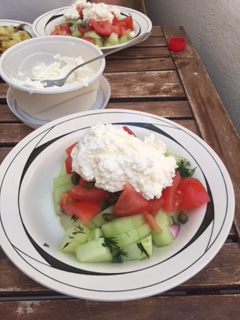
Homemade ‘Naxian Salad’ with xinomizithra cheese
Cows, sheep, pigs and goats are all kept on Naxos. Fresh cows milk, yogurt, and cheeses are all produced on island.
The cheeses. Oh my goodness the cheeses are so good. There are about 4-5 varieties which are traditionally attributed to Naxos and are produced and celebrated here. Although if you ask any Naxian cheese maker how many varieties there are the answer is ‘sooooooo many’!
Our first nibble was when we ordered a ‘Naxian salad’ from a restaurant. It was a salad of tomatoes, cucumber, red onion and capers with xinomizithra (sour) cheese on top. It was delicious. We now make our own every day or so.
Wine and Kitro
How could a place call itself self-sustaining without producing it’s own booze?!
Naxos has been producing it’s own wine for a long time. According to legend, Dionysus, the Greek god of wine and revelry, was born here. He gifted Naxos with fertile land with which to grow grapes, make wine and be happy.
Wine making is a family tradition here where most families have their own vineyards. There are also plenty of bottled varieties. So far we’ve been sticking with the organic ouzo we came across but will certainly try a wine or two before we leave.
Kitro is something special. It’s a syrupy liqueur with a slight citrus flavor. It’s made from the leaves of the kitron or citron tree and has been produced here for over two centuries.
Apiculture
Beekeeping is alive and well on Naxos. There are about 4,000 hives on the island and many different labels can be found in the markets. The bees mostly feed on thyme and heather and also on sage and oregano as these are the typical plants they will come across. Delicious in some creamy Naxos yogurt.
I want the place I live in to be more like this. To produce and celebrate it’s own sustenance. To share this harvest with the rest of the world, in an interdependent kind of way which does not diminish or exploit the hard work of the people here, but cherishes and protects it.
This kind of lifestyle does not appear to be creating lots of super rich people. But it is creating people who live a meaningful and fulfilling life. A healthy and happy life.
Um, I mean, when in Florence…eat like a Florentine! Neither Pete nor I would call ourselves foodies but we do love tasting the local fare and cooking local dishes. Florence does not disappoint with excellent options and availability of delicious and fresh food.
Cooking and preparing our own food is big part of our journey as we travel for an extended period of time. This not only saves us money but it gives us a great opportunity to hang out at local markets and specialty stores, which is a very pleasant cultural experience in and of itself.
Italy is all about the local markets. We are very fortunate to have a couple of morning markets right around the corner from the little flat we are renting here-see Pete’s blog post. A wide variety of fresh fruits and veggies can be found, as well as cheeses like fresh mozzarella and parmesan. A number of Italian meats like pancetta (a lot like bacon) and Florentine salami are a few of the other offerings-it is an amazing place to shop for the day’s meals.
Right up the street from the markets is a little shop called a foccaccaria. It is a bakery of sorts where we can buy, surprisingly, focaccia (Italian flatbread)! And so much more. Other breads, pastries and so many delicious Italian cookies were behind the long counter. Meats, fish and fresh pastas could also be purchased. I’m working myself up to try the tripe, but for now am sticking with almond biscotti (twice baked cookies) and fresh raviolis.
One of the great things about this place was that even though we were packed in there like sardines, it felt very jovial. It was clearly a meeting place for the community, as people walking in struck up familiar conversations with people already there. This was not a fast process, also. It took about 20 minutes to make a purchase. Luckily we were not in a hurry and enjoyed the hubbub.
Another gathering place is the coffee bars. Oh, the coffee bars! Stand at the bar and drink down your espresso or cappuccino quickly. Or sit down at a table (it may cost more) and stay all day. Whatever your choice, the coffees are so so so good. Anytime we go out now, it is a given to stop at a ‘bar’. There seems to be one around every corner.
My new favorite is the caffe corretto. It is a shot of espresso ‘corrected’ with a shot of alcohol. Just sayin…
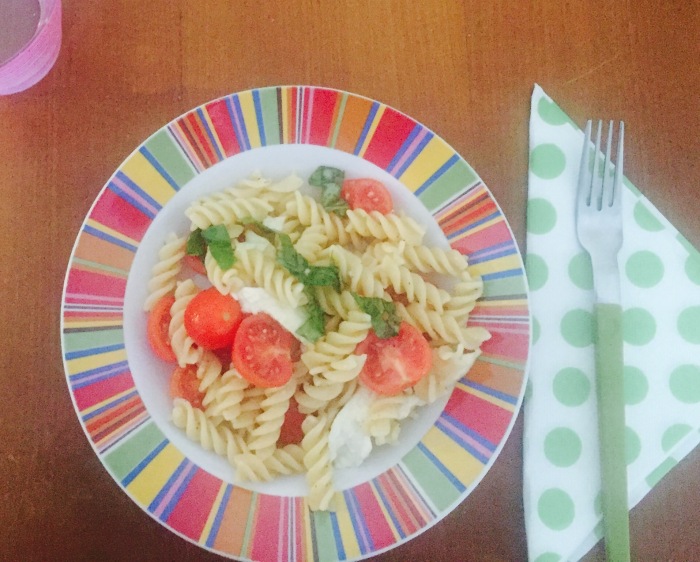
Check out this simple lunch I made. It’s a traditional Caprese Salad with spiral noodles added to make it the main meal.
The ingredients are fresh mozzarella, fresh basil, tomatoes, spiral pasta, olive oil, salt, pepper and a dash of oregano. Boil the noodles to taste and cool under cold water. Toss with enough olive oil to lightly coat the noodles. Add spices and then other ingredients chopped in bite sized pieces. Super easy and super delicious!
This meal cost us just a few Euros to make. It was also a fun cultural experience visiting the markets and shops to find ingredients. Now, if we can just learn to eat it in the slow manner in which it was conceived 🙂
( If you like this post, or this blog, you can subscribe and get emailed whenever there’s a new post by clicking on the green “Follow” button, over to the left. )
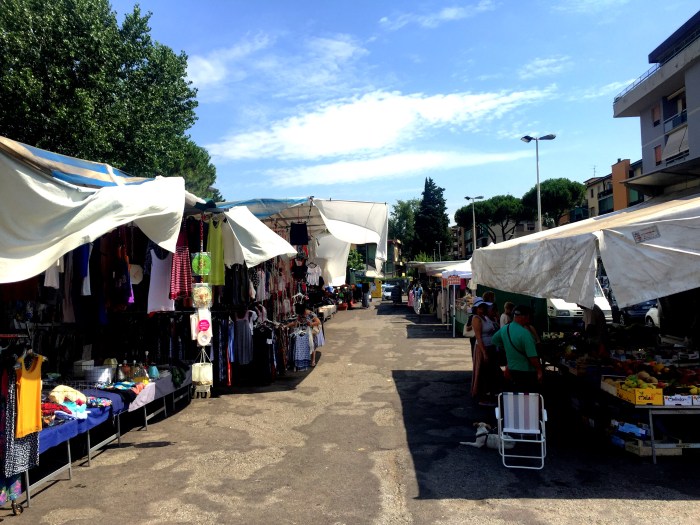
A street market in Florence – dog friendly, chair friendly.
I grew up in the suburbs of Chicago. We drove everywhere, especially to the store. When we shopped for food we bought in bulk. We also ate out quite a bit, even if it was just McDonalds, and I never really picked up the cooking thing. Later, even when I lived in the heart of Chicago on my own, I mostly ate out. I very rarely made anything at home, or shopped for anything other than what I thought friends might want if they stopped by.
I’m now living in Florence for a month, and my time in Italy so far is wonderful for lots of reasons. One of those reasons is trying a different lifestyle when it comes to food.
I’ve done some out-there things before when it comes to my meals: I’ve lived for long stretches almost entirely by eating out. I’ve also done the “Master Cleanse,” where the only thing you take in for close to 12 days is lemon-flavored water with a little maple syrup and cayenne pepper. I’ve spent half a year eating Vegan. What I haven’t done is lead that neighborhood lifestyle, where you go to the market every day or so, buy fresh food, and prep it for all your meals.
That is, until Italy.
Italy in a nutshell, and How to Live the “market lifestyle”
This will not seem strange to a few of you perhaps, but for me it’s hands-down the best part of this experience so far. Basically the pattern of the market lifestyle is this:
wake up early before it gets mind-bogglingly hot
stroll to the local market a block or so away
buy a few fresh things you need for meals today, and maybe part of tomorrow
tomorrow, repeat
Maybe all the people of Italy aren’t doing this, but from what I can see, many of them are. And I have to tell you, it’s every bit as cool as it sounds, or people say it is.
I eat much better, hands down. I have a bit of exercise built into the day, and I feel like I’m getting things done. The quality of food I’m taking into my body every day is hugely improved. I feel more self-sufficient, and also there’s built-in quality timeas you’re going about hunting-gathering-preparing. Also, it’s so much cheaper to live this way than the way I’ve been doing things for pretty much…ever.
I’m talking about markets here, the kind that setup in a lot or along a street somewhere, not individual street vendors.There are slightly different rules and expectations when dealing with a lone street vendor, as opposed to people in the neighborhood market.
I’ll focus on the market in this post. Here are some pointers and observations about shopping in the neighborhood markets here in Florence, that seem to inform well on the good people of Italy and life here in general.
The markets are daily events, walkable from where most people live. This isn’t a special “last Friday of the month” kind of thing; it’s every day. And though I’m not sure if markets are this prevalent everywhere, but it certainly seems and sounds that way. Within walking distance of where we’re staying there are 2 markets, every day, and this is nowhere near the city center. Traveling to the city center, you can see and read about other markets.
You can buy food, but also more. A wide variety of food including meats, cheeses, breads, fruits and veggies can be had at the markets. It’d be very hard to find something processed; it’s all fresh. Milk, wine, and other drinks are a little less common. In addition, you can also buy housewares and clothing at these markets, many of the little items that would be handy to have during the day like a spatula, a new shirt, or a wallet, things you might not need to replace often but wouldn’t want to drive to a big box store for can be found here.
You greet the proprietor, or wait for them to greet you, before you start shopping. This is traditional, and while they might in fact take your money if you don’t do things this way, you’ll be treated very coldly if you skip this step and just start shopping. In general, everyone from proprietors to customers are very friendly.
Prego, almost no one will speak English. You’ll learn very quickly to get by with pointing, sign language, speaking slowly ( as if this helps someone who doesn’t speak your language understand you ), and learning a small bit of Italian.
You don’t grab something, you point to it. It’s considered very poor form to just grab some fruit, or some item you’re looking to buy from the market. Much better is to catch the attention of the proprietor and point, smiling. They will pick it up and hand it to you. The American way of squeezing all the veggies until you find the right one is not acceptable at the Italian market. The idea is that all the veggies and fruit is fresh, and that no one wants stuff that’s been handled by every potential customer. Also,when they ask you how much you want of something, they are expecting you to tell them how many people what you’re buying is supposed to feed… not an amount like “a dozen” or “half a kilo.” Learning the phrases for “just one person” or “a few people” is very helpful. And yes, this is a little arbitrary, but it’s how things are done.
There are no lines. Maybe you take a number. Queuing in Italy is much different than it is in Britain or France, for example. And by “different,” I mean “no one ever stands in a line.” People either gather towards the front in a mass so they can point, or they take a number ( many stands/businesses have that little number dispenser thingy ) and wait to be called. There is very little conception ( or love for ) standing in line.
There’s really no concept of personal space. People will step right in front of you, or butt up right against you. In the US this is seen as the height of rudeness but in Italy there’s just no sphere of “your space” around you. If people get close to you, they are being friendly, accepting you. Also, another consequence of the no-space/no-line thing is that people will just move to stand right in front of you. If there was space there, clearly you didn’t want to stand in that space. Knowing this ahead of time will save you some stress,and maybe some arguments. This was is tough for me to get along with, but it’s much easier learning to accept it and be cool than to fight against.
Samples, yes please. if you’re shopping for food, most proprietors will offer you a sample, and will provide one if you ask. This is considered normal, if you’re making a decision.
Haggling – maybe. Haggling for price is usually perfectly acceptable if there aren’t others waiting, but if you attempt to haggle and gain no ground at all, like your attempt isn’t even entertained or considered, best not to push. At the markets, there is no expectation of haggling; you’re perfectly fine paying the listed price. This is different between the markets and buying from street vendors.
No-one is in a hurry. And you shouldn’t be, either. There is little or no sense of urgency anywhere to be found in the Italian street market, or as far as I’ve seen in Italy in general. And you should not expect any or bring any sense of urgency with you. The pace is slow and enjoyable, and deliberating about buying this thing or that thing is never rushed. If you’re in a hurry, maybe best not to go to a proprietor or stand with others who will be served ahead of you.
Coins are always better than notes, for payment. Things will be much cheaper than you ( as an American who grew up in the US, I’m supposing ) might think. Also, oddly, there is a shortage of Euro coins in Italy and great preference is shown at the street market for people who spend in coins. If you attempt to buy anything with a note more valuable than 10 Euros ( provided your thingy costs less than that ) you could very well be refused. Additionally, there is no sales tax in Italy; if something is listed at 1.20 Euros, that’s what you’ll pay. No little add-on.
They’ll chase you down to give you 10 cents in change. It’s pretty important to people, apparently. I’m not sure if this is the appearance of honesty, the appearance of not needing the extra 10 cents, or what. But someone will come running after you with your change.
You say goodbye on the way out, like your mom taught you. This goes along with greeting the proprietor, a common ritual and part of the expected courtesy. When you’re done, say thank you and good bye… don’t just walk away. This would be classless, and reflect poorly on your mother. Bless her.
The neighborhood market is open early, done by hot. Especially in the summer, the heat is intense in much of Italy. The neighborhood market is open early to serve people before they go to work, and usually shuts down before noon, to avoid the intense heat. And by “shuts down” I mean they’re done taking everything down by noon, so the proprietors don’t need to be out in the heat; not just so that the customer doesn’t have to be out there.
All in all this conveys a sense of casual, friendly, community-mindedness that seems much more common in Europe, and especially pronounced here in Italy. I’ve bene to several small towns in the US of course, and while I thought people were “friendly,” this is definitely saying something very different than describing them as “open” and “warm” to me as a clear stranger, passing through. Italy goes in for the embrace, and isn’t afraid of a little body contact.

 pau hana life